Choosing Certified cleaning products can significantly reduce allergens and potentially harmful chemicals in your home, supporting a healthier indoor environment
Cleaning products are an essential part of managing allergens and maintaining a healthy home environment for people with asthma and allergies, and for the whole household.
Choosing Certified Asthma & Allergy Friendly® cleaning products and maintaining an effective cleaning routine can significantly improve indoor air quality (IAQ), helping to reduce allergens and potentially harmful chemicals that can trigger asthma attacks, allergic reactions, and other health concerns.
In this article, we’ll explore how effective cleaning products and whole-home solutions (from surface cleaners and detergents to vacuums, HVAC filters, air purifiers and whole home air cleaners) can impact IAQ, why choosing science-backed products is an important step toward a healthier indoor environment and, we will introduce our Certified cleaning product partners.
Why Cleaning Matters for Better Indoor Air Quality
We spend the majority of our time indoors, so the quality of the air we breathe at home is essential to our health. Poor IAQ can be caused by common allergens like dust mite allergen, pet dander, and pollen, as well as chemicals from cleaning products. For individuals with asthma or allergies, exposure to these airborne pollutants can trigger symptoms such as sneezing, coughing, or difficulty breathing. But even for those without respiratory conditions, long-term exposure to poor IAQ can lead to headaches, fatigue, and other health issues.
Reducing allergens and avoiding harmful chemicals in cleaning products can improve IAQ and create a healthier environment for everyone in the home. This is especially important when you consider that 90% of dust in homes contains harmful chemicals, including flame retardants, and that indoor air pollutant levels can be 2 to 5 times higher than outdoor levels, sometimes even exceeding them by 100 times during certain activities.
How Effective Cleaning Routines Affect Indoor Air Quality
Maintaining a regular cleaning routine is fundamental for improving IAQ by eliminating dirt, dust, and allergens that accumulate on surfaces. Cleaning for health, not just appearance, is key.
Regular dusting with a moist cloth helps remove dust and allergens from hard surfaces without redistributing them into the air. Vacuuming with a validated high-efficiency particulate air (HEPA) filter is also essential for reducing allergens from carpets and floors.
Proper ventilation is important during and after cleaning to ensure harmful chemicals and particles don’t remain in the air. Following the manufacturer’s instructions for cleaning products can also help avoid the release of pollutants caused by chemical reactions.
In addition to regular cleaning, preventing mold growth is crucial for maintaining good indoor air quality. Mold can thrive in damp environments, making it essential to remove any mold-damaged materials and thoroughly clean areas affected by mold.
Reducing clutter is another important step, as clutter can harbor dust and allergens, making cleaning more difficult and allowing particles to become airborne. By decluttering and organizing your space, you make it easier to clean effectively and reduce potential allergens in your home.
Complementing regular routines, whole-home solutions such as Certified vacuums, HVAC filters, air purifiers and whole home air cleaners also play an important role in capturing and removing allergens and pollutants from the air, helping to maintain cleaner indoor environments over time.
How Cleaning Products Impact Indoor Air Quality
Cleaning products can impact IAQ in two main ways: through the removal or redistribution of allergens and through the release of chemicals, particularly volatile organic compounds (VOCs).
Allergen Removal: Cleaning products remove allergens from surfaces such as countertops, floors, and fabrics. Effective products capture and remove allergens without sending them back into the air.
Chemical Emissions: Many cleaning products release VOCs into the air, which can contribute to poor indoor air quality. VOCs are chemicals that easily become gases and can lead to both short and long-term health effects.
Hard Surface Cleaning Products
Hard surface cleaning products are commonly used to clean areas such as kitchen counters, bathrooms, and floors. However, not all cleaning products are created equal in terms of their impact on IAQ. The Asthma & Allergy Friendly® Certification Program certifies hard surface cleaning products that meet stringent standards to ensure they are a more suitable choice for those with asthma and allergies, making them also a wise choice for better indoor air for the whole family.
To achieve Asthma & Allergy Friendly® Certification, hard surface cleaning products must meet the following criteria:
- Allergen Removal: The product must remove over 85% of allergens from hard surfaces, ensuring that allergens like dust mite debris, pet dander, and pollen are effectively removed.
- Air Quality: The product must clean surfaces without increasing the amount of allergen and dust in the air above certification thresholds, ensuring that allergens are removed rather than redistributed.
- Ingredient Review: All ingredients in the product are reviewed to ensure that any sensitizing chemicals are either not present or present at levels low enough not to cause concern.
- VOC Emissions: The product’s VOC emissions must be below the certification limits, ensuring minimal impact on IAQ.
By choosing a hard surface cleaning product that is Certified Asthma & Allergy Friendly®, you can have peace of mind knowing that the product has been rigorously tested for both allergen removal and chemical levels.

Laundry Detergents
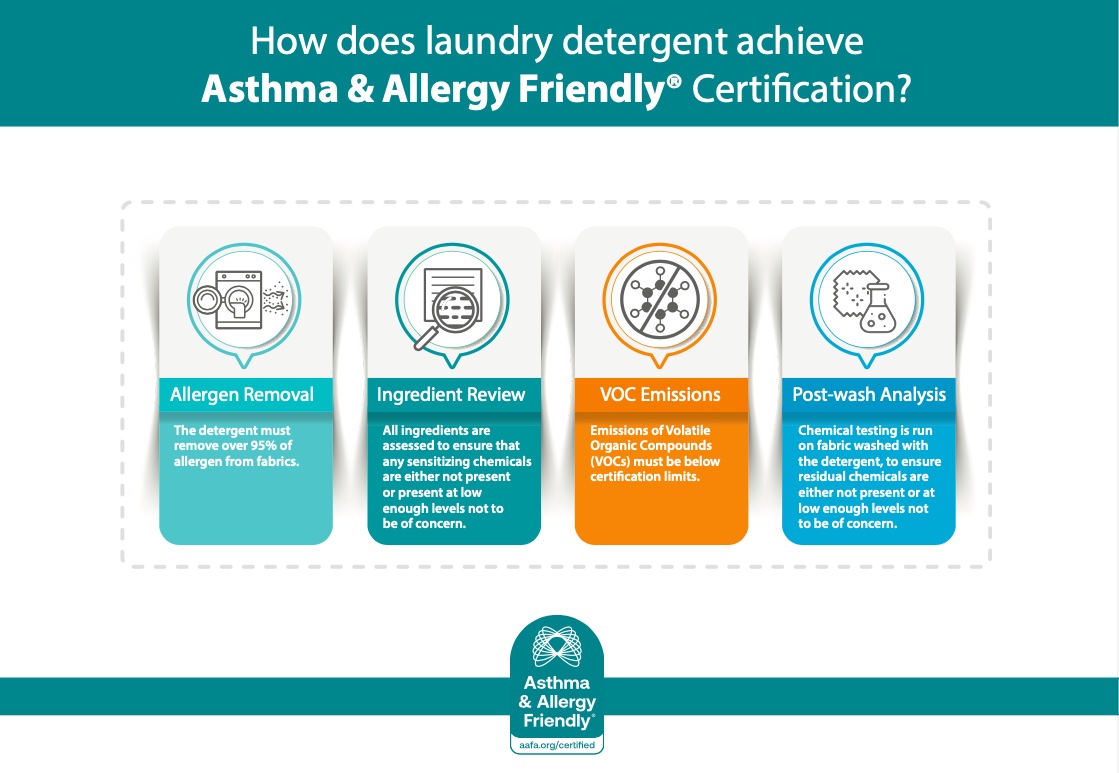
Laundry detergents also play a crucial role in indoor air quality, especially as fabrics can trap allergens like dust mite allergen and pet dander. The Asthma & Allergy Friendly® Certification Program subjects laundry detergents to biological, physical, and chemical testing to ensure they are effective in reducing allergens without contributing to poor IAQ.
Certified laundry detergents are tested for the following:
- Allergen and Dust Removal: Laundry detergents are assessed for their ability to remove allergens from fabrics. This involves testing fabrics seeded with allergen-containing dust and comparing them to unwashed controls to ensure significant allergen reduction post-washing.
- Ingredient Review: The chemicals used in the laundry detergent are carefully reviewed to ensure they are non-sensitizing and non-allergenic.
- VOC Emissions: Laundry detergents are tested in an environmentally controlled chamber to measure the VOCs released over a 14-day period. Certification requires VOC levels to remain below strict certification limits.
- Post-wash Analysis: After washing, the levels of any residual allergenic, irritant, or banned chemicals left on the fabric must be either not present or at low enough levels not to be of concern.
Handheld Dusters
Handheld dusting products and wipes are another cleaning tool that can influence indoor air quality. Dusting can often release particles into the air, but Certified Asthma & Allergy Friendly® handheld dusters are scientifically tested to remove allergens while minimizing airborne dust.
Certified handheld dusters must:
- Remove allergens from surfaces effectively.
- Maintain low airborne particle concentrations during use.
- Contain constituents that are as low as possible in allergenic and sensitizing chemicals.
- Must not emit levels of VOCs above strict certification limits
Certified Products: Whole-Home Cleaning
While surface cleaners and detergents are central to allergen reduction, other household products also play important roles in maintaining a cleaner home and healthier indoor air. Certified vacuum cleaners from LG help capture allergens from carpets and floors using proven filtration, preventing particles from becoming airborne during cleaning.
Certified air purifiers and whole home air cleaners from Alen, Blueair, Rabbit Air, LG, CleanForce and Trane remove allergens and pollutants directly from the air, with minimal harmful ozone production supporting better respiratory health for those with asthma and allergies.
Certified HVAC filters, from 3M and Kleenex®, also play a vital role, as they remove allergens and irritants from the air circulated through heating and cooling systems. To earn Certification, these filters must meet strict standards for allergen reduction, minimal fiber shedding, and effective sealing, ensuring cleaner air is consistently delivered throughout the home.
By expanding the range of Certified cleaning solutions to include these categories, the Asthma & Allergy Friendly® Certification Program ensures that consumers can take a whole-home approach to improving indoor air quality, addressing allergens and chemicals on surfaces, in fabrics, and in the air itself.
Introducing Our Certified Partners at The Clean Show 2025: Renegade Brands and LG
 We are proud to work with Renegade Brands and LG, trusted Certified partners who are committed to improving IAQ through scientifically validated products, both of whom are exhibiting at The Clean Show 2025 in Orlando, Florida.
Renegade Brands: A partner since 2021, Renegade Brands has recently expanded its range of Certified products and, at The Clean Show 2025 this week, will be showcasing its Sweat-X Sport Free & Clear and the newest addition, Pro-Clean Pure Pro Laundry Detergent.
Pure Pro is the first commercial laundry detergent to earn the Asthma & Allergy Friendly® certification, marking an important milestone for facilities in healthcare, hospitality, and senior care where indoor air quality and allergen reduction are especially important. Visitors to Renegade’s booth will have the opportunity to learn how these science-backed detergents meet the rigorous certification standards and how they can help organizations align with health, sustainability, and transparency goals.
Renegade Brands also featured its Sweat-X Sport Free and Clear detergent at the American Academy of Allergy, Asthma & Immunology (AAAAI) / World Allergy Organization Joint Congress earlier this year. The recognition at this medical event shows how Certified consumer products are bridging the gap between scientific research, healthcare, and everyday consumer choices.
Renegade’s involvement in initiatives like George to the Rescue, showed how cleaning products are a fundamental aspect of the “whole home approach” to allergen control and served to highlight their dedication to improving indoor environments for families affected by asthma and allergies.
LG: LG, a longtime Certified partner, has been a pioneer in developing a portfolio of Certified appliances, applying a Whole Home approach to better indoor air quality, including:
- Air purifiers that filter out airborne allergens
- Laundry systems that remove allergens from clothing and bedding
- Vacuums that capture and contain dust and pet dander
- LG Styler that refreshes clothing and reduces allergens
By using these certified solutions together, homeowners can significantly reduce exposure to allergens and pollutants in their living spaces.
The Importance of Third-Party Certification
In a market flooded with cleaning products, it’s important to be aware that not all claims about health and indoor air quality are backed by science. Terms like “hypoallergenic” are often used as marketing tools, but they are largely unregulated and can be misleading. Manufacturers are free to use the term without needing to prove their claims.
This is where third-party certification becomes invaluable. Independent certifications, such as the Asthma & Allergy Friendly® Certification Program, go beyond marketing claims by subjecting products to scientifically strict testing to ensure that they meet rigorous standards. By choosing products that are independently tested and certified, you can trust that they have been proven to perform as advertised.
Conclusion
By choosing Certified Asthma & Allergy Friendly® products from trusted brands like Renegade Brands, LG, Alen, Blueair, Kleenex, Rabbit Air, 3M, CleanForce and Trane you can make a significant difference in reducing allergens and improving indoor air quality. With over 90% of dust in homes containing harmful chemicals, it’s essential to use products that help protect your health while maintaining a clean and comfo