Independently tested vacuum cleaners can reduce allergens, limit dust redistribution, and support healthier indoor environments
With people spending up to 90% of their time indoors, and air pollution levels often higher inside than out, keeping indoor air clean is a year-round challenge. During Indoor Air Quality Awareness Month, we’re highlighting how Certified vacuum cleaners can make a measurable difference by reducing allergens, dust, and microscopic particles that can affect the quality of the air we breathe indoors.
The Importance of Vacuuming for IAQ
Vacuuming is vital for maintaining good IAQ, especially if someone in your home is impacted by asthma or allergies. Floors can harbor large amounts of dust, allergens, and irritants, which can easily become airborne. A vacuum cleaner that effectively removes these allergens, and prevents them from re-entering the air and entering the ‘breathing zone’, is a key part of managing indoor environmental triggers.
A Certified Asthma & Allergy Friendly® vacuum cleaner ensures that these particles are captured and sealed, reducing potential triggers of asthma or allergic reactions and contributing to better indoor air quality.
What Makes a Vacuum Certified Asthma & Allergy Friendly®?
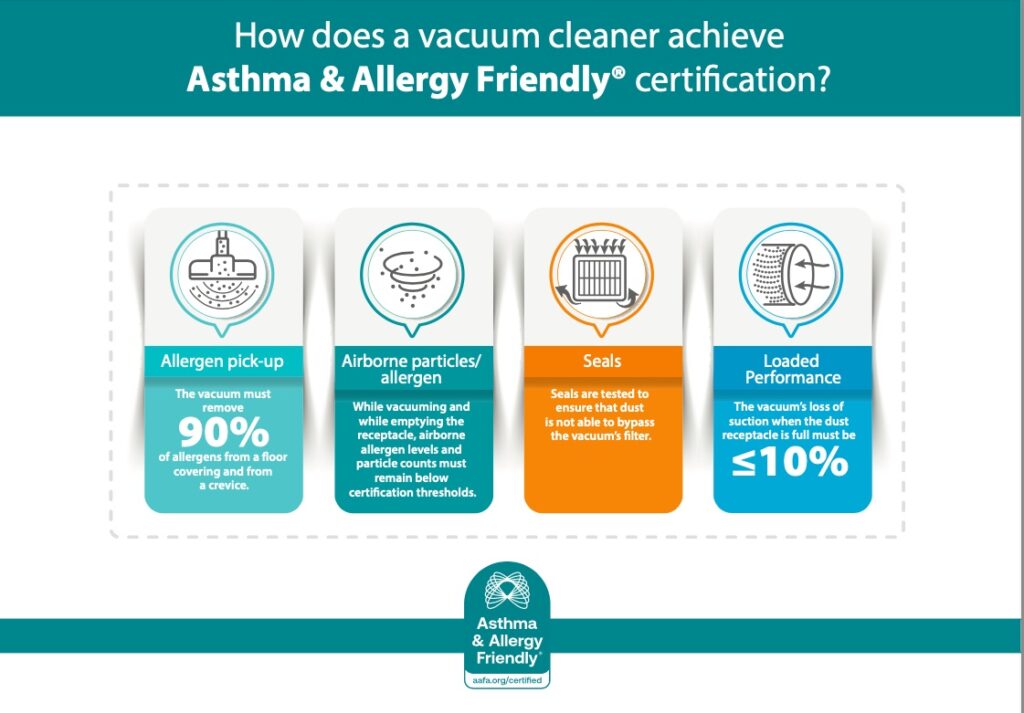
The Asthma & Allergy Friendly® Certification Program subjects vacuums to extensive testing under controlled conditions. To receive certification, vacuums must demonstrate their ability to remove allergens, control dust emissions, and maintain performance over time. Below are the key criteria a vacuum must meet to earn certification:
- Allergen Pick-up: A vacuum must remove at least 90% of allergens from both a floor covering and a crevice. This is crucial for effectively reducing common household allergens like dust mite allergen, pet dander, and pollen, which tend to settle into carpets and rugs. Testing is carried out in a controlled environmental chamber, where a piece of floor covering is seeded with test dust that contains dust mite allergen and cat allergen.
- Airborne Particles/Allergens: A vacuum’s ability to prevent allergens from becoming airborne during use is another critical factor. Certified vacuums are tested to ensure that airborne allergen levels and particle counts remain below certification thresholds, both while vacuuming and when emptying the dust receptacle. This is essential for preventing the redistribution of dust and allergens into the breathing zone, which can otherwise exacerbate respiratory conditions.
- Seals: The integrity of a vacuum’s seals is also evaluated to prevent dust from bypassing the filter and re-entering the indoor environment. A Certified Asthma & Allergy Friendly® vacuum must have robust seals to ensure that all the air passing through the machine is filtered, providing an extra layer of protection against allergen leakage.
- Loaded Performance: Finally, the vacuum’s suction performance is tested with a full dust receptacle. A vacuum must maintain less than a 10% loss of suction to ensure that it continues to perform effectively even when it’s not empty. This ensures that your vacuum can still remove allergens and dust without losing efficiency as the dust bin fills up.
These requirements help ensure the vacuum cleaner is capable of real-world allergen control and consistent performance.
Certified Vacuums: Why Third-Party Validation Matters
With so many vacuums on the market making similar health claims, third-party certification is essential to help consumers make informed decisions. Unlike marketing terms such as “hypoallergenic,” which are often unregulated and may not guarantee the efficacy of a product, third-party certification ensures that products have been rigorously tested by independent labs and meet stringent standards.
The Asthma & Allergy Friendly® Certification Program works in partnership with the Asthma and Allergy Foundation of America (AAFA) to provide a trusted guide for consumers. The program ensures that products claiming to support better indoor air quality, like vacuum cleaners, actually deliver on their promises. By choosing a Certified vacuum, you can be confident that it has been scientifically tested to support better IAQ and create a healthier home environment.
Practical Tips for Vacuuming and Allergen Control
To maximize the allergen-reducing benefits of your vacuum cleaner, follow these practical tips:
Vacuum Regularly: Vacuum at least once a week, focusing on high-traffic areas and places where allergens are likely to accumulate, such as carpets and upholstery. If possible, use a Certified robotic vacuum in tandem with the regular full vacuum to help minimise dirt and allergens.
Use Advanced Filtration Systems: Ensure your vacuum is equipped with an advanced filtration system that efficiently traps dust, pet dander, and other airborne particles.
Empty Dust Receptacles Carefully: When emptying the vacuum’s dust bin, do so in a well-ventilated area or outdoors, if possible, to avoid reintroducing allergens back into your home.
Focus on High Allergen Areas: Don’t forget to vacuum areas where dust mites thrive, such as mattresses, upholstered furniture, and curtains.
Conclusion
Good indoor air quality begins with informed choices. By choosing a vacuum cleaner that’s been independently tested and Certified Asthma & Allergy Friendly®, you’re investing in science-backed assurance that your cleaning routine supports better health and cleaner air. This October, commit to a cleaner home and healthier breathing by exploring Certified vacuum options.