Choosing Certified laundry detergents can significantly reduce allergens and potentially harmful chemicals in your home, supporting a healthier indoor environment
As Indoor Air Quality Awareness Month continues, it’s time to turn our attention to a surprising contributor to the air we breathe, laundry detergent. While we often focus on ventilation or filtration, what we use to wash our clothes can also influence indoor air quality (IAQ). In this article, we’ll explore how laundry detergent can impact IAQ and why choosing science-backed products is an important step toward a healthier indoor environment.
Why Detergent Matters for Better Indoor Air Quality
We spend the majority of our time indoors, so the quality of the air we breathe at home is essential to our health. Poor IAQ can be caused by common allergens like dust mite allergen, pet dander, and pollen, as well as chemicals from cleaning products and laundry detergents. For individuals with asthma or allergies, exposure to these airborne pollutants can trigger symptoms such as sneezing, coughing, or difficulty breathing. But even for those without respiratory conditions, long-term exposure to poor IAQ can lead to headaches, fatigue, and other health issues.
During washing and drying, volatile organic compounds (VOCs) and fragrances from detergents can become airborne, contributing to indoor air pollution, especially in enclosed laundry spaces. Reducing allergens and avoiding harmful chemicals in laundry detergents can improve IAQ and create a healthier environment for everyone in the home. This is especially important when you consider that multiple studies find that certain consumer-product chemicals (such as phthalates and flame retardants) are present in 90% or more of U.S. indoor dust samples. And when it comes to allergens in homes – nearly 50% had at least 3 allergens exceeding elevated levels. Taking into account that the average person breathes approximately 2,000 gallons of air daily, it is clear that we need to take action.
Laundry Detergents
Fabrics act like sponges for allergens such as pet dander and dust mite allergen, so the effectiveness of your laundry detergent can have a real impact on your home’s air quality. Some of the chemicals commonly used in laundry detergent can cause allergic reactions, and many detergents release vapours when used. The Asthma & Allergy Friendly® Certification Program subjects laundry detergents to biological, physical, and chemical testing to ensure they are effective in reducing allergens without contributing to poor IAQ.
We take a balanced approach in certifying products. It is not possible to make laundry detergent without using chemicals, and there are some chemicals which can have a negative effect but which are necessary for different reasons. We want to identify laundry detergents that do not contain ingredients that are unnecessarily harmful. And we want to make sure that any necessary chemicals that can sometimes cause an allergic reaction are present at as low a level as is needed for them to function as intended.
Certified detergents are formulated to balance cleaning performance with reduced chemical emissions and allergen removal, ensuring that every wash contributes to a cleaner, more comfortable home environment.
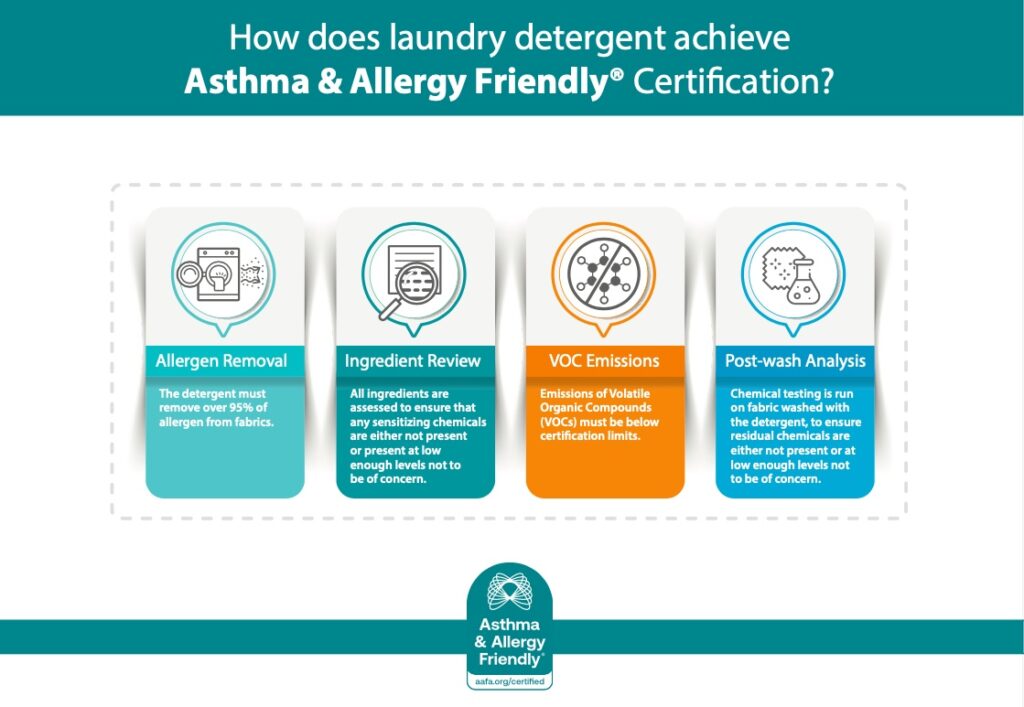
How does laundry detergent become Certified Asthma & Allergy Friendly®? It must pass strict scientific testing across four key areas to support healthier homes
CERTIFIED laundry detergents are tested for the following:
- Allergen and Dust Removal: Laundry detergents are assessed for their ability to remove allergens from fabrics. This involves testing fabrics seeded with allergen-containing dust and comparing them to unwashed controls to ensure that allergens are more than 95% reduced compared to unwashed control fabric.
- Ingredient Review: The chemicals used in the laundry detergent are carefully reviewed to ensure they are non-sensitizing and non-allergenic.
- VOC Emissions: Laundry detergents are tested in an environmentally controlled chamber to measure the VOCs released over a 14-day period. Certification requires VOC levels to remain below strict certification limits.
- Post-wash Analysis: After washing, the levels of any residual allergenic, irritant, or banned chemicals left on the fabric must be either not present or at low enough levels not to be of concern.
The Importance of Third-Party Certification
In a market flooded with laundry detergents, it’s important to be aware that not all claims about health and indoor air quality are backed by science. Terms like “hypoallergenic” are often used as marketing tools, but they are largely unregulated and can be misleading. Manufacturers are free to use the term without needing to prove their claims. With so many detergents claiming to be “eco,” “gentle,” or “green,” independent certification helps bridge the gap between marketing and science, giving consumers confidence that what’s on the label has been proven in the lab.
This is where third-party certification becomes invaluable. Independent certifications, such as the Asthma & Allergy Friendly® Certification Program, go beyond marketing claims by subjecting products to scientifically strict testing to ensure that they meet rigorous standards. By choosing products that are independently tested and certified, you can trust that they have been proven to perform as advertised.
Conclusion
As Indoor Air Quality Awareness Month draws to a close, it’s a reminder that the air we breathe is shaped by everyday choices, including the products we use to clean our laundry. Laundry detergents may not be the first thing that comes to mind when thinking about indoor air quality, but their ingredients and performance have a direct impact on the allergens and chemicals that circulate indoors.
By choosing Asthma & Allergy Friendly® Certified laundry detergents, you’re selecting products that have been scientifically tested to remove allergens effectively and limit chemical emissions that contribute to poor indoor air. It’s a practical step toward creating a home environment that supports everyone’s well-being.